Sunday, May 15, 2011

Theatre of the Dead #3 - Zombi 2 (1979)


Director: Lucio Fulci
Stars: Tisa Farrow, Ian McCulloch


Review:


The first natural reaction off seeing the title would be: where is Zombi 1? Upon release in Italy, the title of Dawn of the Dead was changed into Zombi, and in order to capture the success of Dawn of the Dead they decided to call this movie Zombi 2. In the States there is no Zombi 1 so the poster uses the title Zombie. Despite the confusing title, this movie have nothing to do with Dawn of the Dead.

I find this looks amazing visually. With fires it looks like gate of hell.

Zombi 2 takes a more traditional horror movie approach to the zombie scenario. In Night of the Living Dead zombie just appears right at the beginning of the movie with no explaination. In Dawn of the Dead, the zombie already taken over right at the start. Zombi 2 gives the backstory on how the zombie raises.

The movie starts with a discovery of an abandoned ship in New York. Two policeman go abroad to investigate, but one of them got killed. The police force believes that it has something to do with the shipowner, but the shipowner's daugter and a reporter does not share the same thought with the police. They find a death letter from the shipowner on the ship, that he was held on an island. They decided to went on that island, and find out the dead is coming alive.

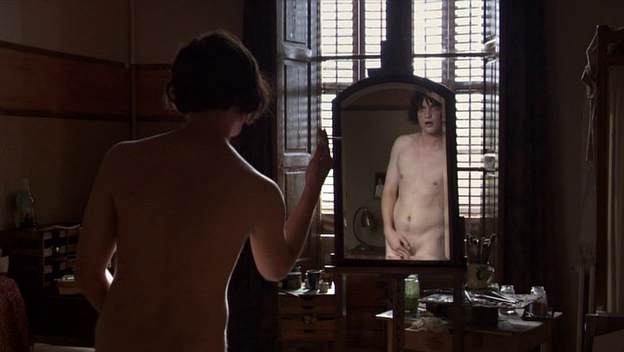
She would turn around but I dont want to make this an adult site.

We seem to have heard the story many times before (the basic plot is a bit similar to Tombs of the Blind Dead 1971, in which in both movie the characters went to some far places and the dead come to kill them), and it contains all bad horror movie omens, such as a love subplot and un-necessary nudity. In the first half of the movie it does get a bit boring while the characters try to create suspense when we all have already know the answer. But later when the zombie attack is in full motion,the shock value even exceeds Dawn of the Dead. The zombie makeup looks way better and designed that they decays, and their flesh can easily be scratched off since they are dead. They rises from the grave with all the worms and insects, and looked way more nasty.

Compare these with the Dawn of the Dead zombies and you know what I mean.


Another thing this movie brings to the zombie formular is it gives more attention to the cause. In Night of the Living Dead we were told briefly that the zombie coming back to life is because of an outer space radiation bought by a spaceship back from venus. Nowadays we know that radiation does not work that way, but back in 1968 people was fed by tonnes of sci-fi movie of the 50s about ridiculous consequences of exposure to radiation. People in 1950s were afraid so much of radiation since they witnessed the nuclear bomb explosion first hand.

A zombie fighting a shark. The shark is real by the way.

Coming back to this movie, it goes back to the root of zombie legend, that the cause of zombie is voodoo, like in the movie White Zombie (1932), though we were not definitely told. The native on the island said it is voodoo, but the doctor that is researching the zombie phenonmenon on the island, speaking representing our logic, does not believe. However he tried pathology, virology, radiology, etc and nothing gives an explaination. So at the end we were not sure if it is really the cause, but it thrills you more with the mystery than just telling you it is a virus.

Ever played Resident Evil 4/5?

Zombi 2 is worth watching for its shock value, and it defines what a zombie looks like today. It spawns its own line of sequels, though seemingly not related to each other, and none of the sequels is worth mentioning. The director Lucio Fulci went on to make some other zombie movies that is unrelated to Zombi 2, like City of the Living Dead (1980). Nowadays George A. Romero is commonly hailed as the person who created zombies, but I consider Lucio Fulci's name in the Hall of Fame of the zombie genre with Romero and another director that I have yet to introduce.

Saturday, May 14, 2011

Theatre of the Dead #2 - Dawn of the Dead (1978)


Director: George A. Romero
Stars: David Emge, Ken Foree, Scott Reiniger


Review:

In reality, zombie apocalypse, among other apocalyptic scenarios, is the easiest to deal with. Just do not send infantry troops in, but tanks or armoured vehicles. The event of Night of the Living Dead last for a night, but people love the concept so much, it never ends.

Dawn of the Dead seems to pick up right after Night of the Living Dead, but it stands alone. Zombies are now at large, and people want to survive. A group of people flew off in a helicopter, and landed on a shopping mall for some supplements. Soon they realize it may be not such a bad idea to stay in the mall and live on all of the supplements in it.

Shopping mall with zombie shoppers. Is there really a big difference?

George A. Romero extends the idea of zombie apocalypse, than not just to survive for the instant, but how to survive in a matter of a long time, at least weeks. The answer is capture a mall, in which you have almost infinite supplies. It's fun to even think about that a whole mall is upon your disposal, and how to survive with the existence of flesh-eating zombies. We watch them having fun with all the things in the mall, and even playing with the zombies, using them as target practice or teasing them. At some times we even wished we were in it with them. They made the mall suitable for themselves, and safe from all the zombies, and that is almost a tutorial on how to survival a zombie apocalypse.

Step 1: Find a safe spot that is free from zombies.
Step 2: Go in and out of your hiding spot through secret tunnel  that zombies would not know.
Step 3: Block the entrance with trucks. I never fully understand this.
If they cant get in, they cant. I guess in a movie you have to do something stupid.

Underlying the entertainment, there is a social satire implied in the movie. We see the zombies walking around in the mall, and heard the characters asked "Why they come here?". Yes, why do we go to malls? Is that really because we have something to buy? Or even having any definitive aim? How many times have we go to malls just because we have to do something or to spend some money. In a sense the zombie virus represents consumerism, turning us into zombie that have no thinking. In 1978 it maybe malls. Now it probably be iPhones. Maybe its for the better. When zombie apocalypse come we just distract them with an iPhone.

The zombie makeup is a little dated. Hey but that's 1978.

In a whole the movie is very much like a walk of live. We know that life is a shithole, zombies roaming freely, but we want to find fun out of it. Later we looked back and realize that life is still shit, and the zombies are still haunting us, and we have the face the inevitable fate, which is death. Maybe I'm going too far and this is not that kind of movie. But without the recognition of the satire or implication, as I have said, it is interesting to even watch how much fun to survive in a zombie apocalypse.

Thursday, May 12, 2011

Theatre of the Dead #1 - Night of the Living Dead (1968)


Director: George A. Romero


Review:

In this little series "Theatre of the Dead" we shall go through some important movies in the zombie sub-genre to give myself a direction on what movie to watch. There maybe zombie movies that I will not mention maybe because I didnt know about them, or couldnt get my hands on, or I do not consider those to be zombie movies. By zombie I refer to the common understanding of the term, without rigourously give a definition here. I generally do not consider mind-controlled people zombies, so White Zombie (1932), which tells a story that a witch doctor hypnoize people to work for him, is not in my sense a zombie movie. Therefore in that sense, we will start with George A. Romero's Night of the Living Dead (1968), which is regarded as the first zombie movie in many sources.

The story tells Barbara who went to a cemetry with his brother Johnny to visit their father's grave. A zombie just came attack them. Johnny hit a rock and died, and Barbara fleed to an apparently abandoned house. Later another guy Ben came to seek shelter, help Barbara to calm down and barricade the house against the zombies who started gathering outside. Its turns out a couple Tom and Judy, and a family Harry, Helen and their sick daughter was hiding in the house cellar. The two groups of people had an argument of whether they should stay in the barricaded house, or locked down in the cellar, while the zombies soon massed a large number.

First group of "modern" zombie in movie history

Barbara is basically a useless character that was too fragile, and in the whole movie she have done nothing but stands around like a lobotomized mental patient. The only usage she's in the movie is to scream. Ben argues that the people should stay on the ground floor, since they can still get out if things get out of hand. We agree with him since he seems to be a nice guy, and we watch him helped Barbara calmed himself and gives order in barricading the house. We dismiss Harry, who suggests to lock themselves in the cellar and defend that one only door, because we know he was still hiding in the cellar even if he heard screaming and cares only to save himself. The irony is all the casulties in this movie we could blame on Ben's decision. If you agree with Ben all along, you may consider youself fail in surviving a zombie apocalyse.

People couldnt help but get into argument on who's the boss.

Zombies are not from some ancient folklore, and almost all perceptions we have with zombies come from this movie. The rules are followed, imitated, modified but never trully broken. So zombies are dead people coming back to life. They have low intelligence, and know nothing other than eating, and they hungry for human flesh. They would not stop regardless the wounds on their body and can only be killed when the brain is destroyed. And one important point is that a human will become a zombie if bitten by them.

This film is also a landmark on movie gore. Shot in B&W may not just for the low budget.

The rule of "Chekhov's Gun" tells us if in a play, there is a loaded gun hanging on the wall, it will be fired later in the play. If zombies can infect others through bites, they will. Therefore there will always be at least one member of the cast be infected, and his companions struggling to kill him. In this movie it is that sick daughter, who was actually bitten and became a zombie. Their parent could not kill their own daughter, and could only watch the daugter killed and ate themselves. For countless zombie movies that follow this rule, it was this first time the rule was done that is most disturbing for me.

A little zombie coming to cut you open and eat your guts.

The Night of the Living Dead was remaked in 1990, in which the remake is almost the same movie, down right to the dialogues, which I must say it is a waste of film. The remake makes more use of the character Barbara, and changes to a happier ending but nothing really differs too much. But this original masterpiece was shot in Black-and-White, which may turn some people down. The remake maybe a substitute for them to know about the plot.

Sunday, May 8, 2011

Ichi the Killer (2001)


Director: Takashi Miike
Stars: Tadanobu Asano

Review:

Ichi the Killer is the film adapation of the manga in the same name. I have seen the manga and it is one of the sickest manga/comic/anything I have ever seen.When it becomes a film, it turns sick into just weird.

A major problem with this movie is it tried to put the plot of the manga into 2 hours, cutting a lot exposition and left no time for character development, turning the story into an incoherent pile of shit. In the manga everybody is sick and in this movie everybody is stupid.

The most disgusting title screen ever. The white slime is semen. Yuck.

So a killer named Ichi killed a Yakuza boss, and the boss' right hand man Kakihara go after him. An old man shown up and told Kakihara that another Yakuza boss did that, and Kakihara tortured him for some answers, with boiling oil poured over his naked body dangling from the ceiling. But it turns out the old man lied (Duh?), and Kakihara was expelled from the gang. And....I lost track honestly. The old man made a deal with the tortured Yakuza boss to kill all Kakihara's man, Ichi kill somebody, Kakihara found somebody to torture, Ichi kill some whore, anyway just killings and killings.

Killing aftermath

In terms of violence and gore it do keep pushing the boundary, but the audience found no reason for that to happen, like killing is the whole point of the movie. In the manga it is sick since it tells a story that somebody wants to kill, and somebody wants to be tortured to the point of even being sliced up. You feel the characters are lunatics and disturbed that if such person even exists. In the movie you feel that they are just a bunch of dumbasses. When Kakihara knew Ichi was after him, he went out searching for Ichi like a stupid kid running to a theme park, and when he found Ichi he fleed. Ichi was hynotized by the old man to kill those people, thought that they were the people who bullied he in school. Afterthat he thrown up and said "I dont want to kill anymore", and the old man said "Dont you want revenge to the bullies?" and Ichi said "But they are not the bullies!" Duh? The characters do act the same way in the manga, but we understand their menalities because they are developed, and here the development was sacrificed to squeeze everything into the movie.

It may seem to be inappropriate to talk about plot in this cult movie. If you just want gore scenes, this is the one for you. If you want to know what is what and why everybody is doing everything, go watch the manga. If you want to watch a standalone movie, watch something else.

Friday, May 6, 2011

Barton Fink (1991)


Director: Joel and Ethan Coen
Stars: John Turturro, John Goodman


Review:

The Coen Brothers have been well known of making films with a lot of twists that spins your head around, and despite the lesser circular momentum this gives to your head in the first viewing, it may be the weirdest of all their works.

Barton Fink, played by John Turturro, is a play writer and receives many critical acclaim in Broadway. He however is not satisfied and want to achieve new high in artistically. He received an offer from a film producer in Hollywood, and write for a wrestling picture. However he have a writer's block, and during his course of overcoming it, he meet several characters that all appears as common people with dark little secrets.

I saw this movie a few days ago and did not know what to talk about it, and did a little research on this film. So I was told that this film contains high amount of symbolisms. However I found none of the symbolisms actually hold up throughout the whole movie.

I was told that the hotel room Barton Fink was staying represents his mental state. The hotel room was hot, and the wallpaper fell off, but we didnt see it actually correspond to Fink's emotion. Yes the wallpaper was not shown to be falling off when Fink's is in full motion with his script, but that would be because Fink was so into his work that he didnt notice it. To me the room is more like Hollywood, which is alienating and unwelcoming, but that would be too shallow to be a symbolism.

"Your room does that too?"

Another common symbolism I have seen is the hotel, when it caught in fire at the end, symbolize Hell. It does look like Hell, but I fail to see what is the point there. So the hotel is Hell, and? Fink can escape pretty easy, and not much to be tormented. There is not much point to have a symbolism if it doesnt mean anything?

It does look like hell.


I am more interested in the characters. Barton Fink is a writer that not only want the audience to love him, but also write for artistic values. He want to write for common people, and keep his connection with the common people. But he is not common people. He talks with screenwriting jargon when excited like a literate, and did not listen to the story of ordinary people. We all heard the theory that movies are good because they were about ordinary people that we connect with, but the dilemma is ordinary people attend boring lessons for 9-5 and watch TV for the night, or work 9-5 typing and get drunk get night, and repeat it the next day. And I believe nobody want to see that for the whole movie. So in order to interst people, the movie most get un-common.

The characters are un-common in such way. A successful writer who Fink admires turns out to be a drunk with his secretary done all his work, and a boss that likes your previous work revealled his interest in only how much money you make for him. An ordinary fat insurance salesman turns out to be a lunatic. So Fink got inspired by them, but only to be dismissed from the studio. Aint that ordinary? Bosses usually know shit.

A gentleman, a writer, and a drunk.

Even the symbolism doesnt work for you, it is still an entertainment movie just to see the awkward situations that arouse when people with totally opposite personalities fact each other. Fink talks with the guy next door, complains that he complained about him making too much noise. Fink faces his boss, who so passionate about Fink's work but only interest in how many he could make from the picture, seeking answers from Fink who did not have any since he wanted something more artistic and not just for amusing the crowd. You witnessed and laughed since you did not know how to resolve it.

This is a movie open for different kind of interpretations, and you can have your own. Though none of the interpretations such to fit in perfectly, it maybe the whole beauty of it that great films can sometimes be whatever you want it to be, though I would say it was to vague to say what it really is.

Monday, May 2, 2011

The Hills have Eyes (1977)


Director: Wes Craven
Stars: Susan Lanier, Robert Houston, John Steadman


Review:

A family was passing by a desert to California Los Angeles. They were lost and had an car accident, which made them stuck in the middle of nowhere, surrounding by rocky mountains. They thought this was a picnic but spotted by a weirdo family who were starving and could eat about anything.

This is the rare case that the 2006 remake scored higher in IMDB than this original 1977 classic. I have seen the remake beforehand and basically they followed the same plot, excep the remake adds an explaination on the weirdos. This may have ruined the experience of watching this movie for me since I have seen something like this, and in terms of special effects and production values, I have to say the remake looks better. But I have to give credit to the original disturbing idea of raping a woman besides a baby.

In term of exploitation value it does not go far either. There are gunshots, stabbing, biting and dog guts but nothing really stands out. Compared to Wes Craven's own previous work The Last House on the Left (1972) this looks much tamed. Though I am interested in watching a dog get its revenge after knowing it's partner, another dog, was killed and eaten. It threw somebody over the mountain, biting deep on one's feet, and killed a guy by tearing open his throat. Dogs are intellect and I absolutely adore them.

Wes Craven may have become the most successful, money-making horror movie director, after creating the Nightmare on Elm Street series and Scream series, but along the way he's getting tamed. More movies he make, more toned down is the violence in the movies. At the point he got to Scream (1996), it had become a commercial film. Though it opened the door for me on horror movies, horror movie fans demand daring films that do things others could not accept. That is horror.

I would consider The Hills Have Eyes a minor classic, and even for a guy like me who generally hate remakes, the 2006 remake of The Hills Have Eyes may entertain you more if you do not care about originality.

Sunday, May 1, 2011

Little Ashes (2009)


Director: Paul Morrison
Stars: Robert Pattinson, Javier Beltran


Review:

This is a film I think would be much enjoyable if you are more familiar with art, and know who Salvador Dali, Garcia Lorca and Luis Bunuel are. I am not into paintings or poets, so it would be natural for me to oblivious to who they are, but I really should not miss Luis Bunuel. He is a famous surrealist director, with works such as The Discreet Charm of the Bourgeoisie (1972). Well I'll catch up sometime.

Despite my ignorance to these figures, this is still an effective movie, especially towards the end. It tells the story of the relationship between Salvador Dali and Garcia Lorca, or should I say more directly, homosexual love. We see the young people that's into art, with classy talks and tasteful lifestyle in the University, and a newcomer that is Salvador Dali. Garcia Lorca and Salvador Dali both attacted each other, and kept pushing the boundary together, but finally Dali found he could not do homosexual intercourse.

Would you fuck me? I'd fuck me. I fuck me hard.

This is the turning point of the movie, not only does we witness Dali change, but also the point that the movie from mediocre to touching. In the first part it is lacklusting, which we see how they meet each other and how they were in love. But when Dali failed to have sex with Lorca, he started to change. He left Lorca to Paris, and when he comes back he seemed to have become a different person. He was full of arrogance, fucked all kind of women in paris and acted as if their love had never happened. But we can penetrate through his mind that he is just jealous.

Dali: "I think it's something new."
Lorca: "It's extraordinary. ... (You were drawing) Me."
Flickaholic: "? What?"

One memorable scene would be Dali insulting and at the same time confronting Lorca for his homosexuality, and Lorca's girlfriend Magalende came for a fuck. Lorca fucked her in front of Dali, and all three of them were crying. There is so much contradicting emotion filled with this scene: Dali's love with his fear of being queer, jealously towards the Magalenda who was having sex with Lorca, and how this fuck tramatize him, Lorca's anger towards Dali's change, and Magalenda's happiness and sadness on having sex with the man she loves but knowing that the man had someone else on his mind.

In additional, I do like the classy feel in the film. The characters talks and act classy, and I do wish I am surrounded by this kinda people. I like intelliect talks and the pride of being superior, not about stupid iPhones. But it does not seems to happen.

Robert Pattinson is panned for his appearance in the Twilight movies, and watching Little Ashes I believe he is a good actor. He convoyed the emotions to the audience in just the right amount of not overdoing it. I havnt seen any of the Twilight movies and judging from the plot it would have been sucked disregard who's doing it. Just give this guy a chance.

This is not as impressive as some other homosexual films, but if you not a homophobia, maybe this will be touching you.